Start with contact points
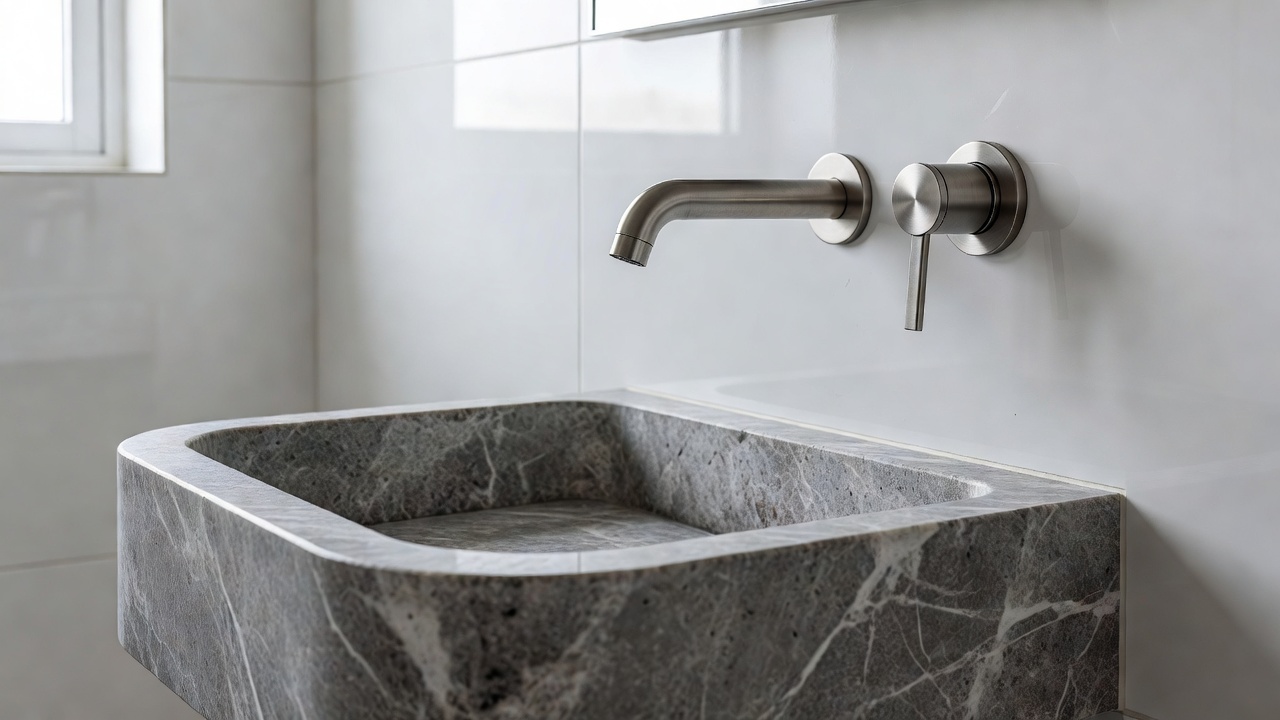
List the surfaces your body touches: floor, shower seat, basin edge, controls and the place where you lean while drying. These contact points deserve more attention than a distant feature wall. Temperature, texture, edge shape and cleaning access all contribute to perceived quality. A restrained palette can feel rich when its junctions are carefully resolved.
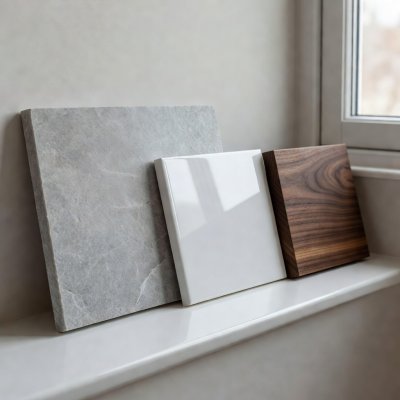
Bring samples into the room rather than deciding beneath showroom lighting. View them beside towels, cabinetry and the proposed light source. Wet a supplier-approved sample and allow it to dry. Ask whether its appearance is representative of the batch and whether natural variation is expected. For stone, inspect the actual slabs when the scale of veining matters.
Understand stone beyond its name
Marble, limestone, granite and other natural stones differ substantially, and commercial names do not tell the whole performance story. Some stones react to acidic cleaners or toiletries; some show moisture darkening or absorb stains. A honed finish changes reflection and feel, but it does not automatically make the surface slip resistant or maintenance free.
Ask the supplier for written guidance on suitability, sealing, cleaning and repair. A sealer is not a universal barrier against etching or every stain. Decide whether gradual patina is welcome or frustrating in your household. The Natural Stone Institute provides useful care information, but your selected stone, finish and installation need their own documented instructions.
Treat porcelain as a system
Porcelain can offer low water absorption and consistent appearance, yet the tile is only one part of the installation. Substrate preparation, waterproofing, adhesive selection, movement joints and edge details influence the result. Large-format pieces may reduce visible joints, but they can introduce handling, flatness and access challenges. They do not eliminate grout or the need for movement accommodation.
EN 14411 classifies ceramic tiles, while ISO 10545 describes test methods for relevant characteristics. Ask for product-specific declarations rather than accepting “bathroom suitable” as a complete specification. A wall tile is not necessarily a floor tile, and a dry-area floor product is not automatically appropriate in a shower.
| Material | Useful quality | Care or detailing question |
|---|---|---|
| Natural stone | Variation and tactile depth | Will water, acids or cleaners alter this specific stone? |
| Porcelain | Consistent, durable surface options | What substrate, slip data and installation system are required? |
| Timber | Visual warmth in dry zones | How are edges, joints and hidden faces protected? |
| Metal finishes | Precise touchpoints and detailing | Which cleaning products affect the coating or warranty? |
Specify wet-floor performance carefully
Slip resistance depends on conditions, not just appearance. Water, soap, surface wear, slope and cleaning residue can change performance. Ask which test method was used and whether the reported result is relevant to a wet barefoot area. EN 16165 brings together methods for evaluating pedestrian surface slip resistance; different test methods and classifications should not be treated as interchangeable scores.
A heavily textured surface can improve grip in some contexts while also holding residue and becoming harder to clean. Consider this trade-off through samples and professional advice. Drainage, cleaning routines and safe transitions are part of the same decision. Never rely on a photograph, a finger test or a generic “non-slip” label to establish suitability.
Give timber and metals appropriate roles
Timber can soften a dry vanity zone without being asked to perform as a constantly wet shower lining. Discuss dimensional movement, ventilation around cabinetry, edge protection and repairable finishes. A sustainably sourced label does not establish wet-area suitability. The Forest Stewardship Council addresses responsible sourcing, while the manufacturer must explain the technical limits of the product.
Brass, stainless steel and coated tapware also have different care needs. Living finishes may change deliberately; plated or coated finishes can be damaged by abrasives and inappropriate chemicals. Compare replacement availability as well as appearance. Matching a finish across several manufacturers can be difficult, so view the actual samples together rather than relying on similar product names.
Design a maintenance rhythm
Write a realistic cleaning routine before final approval. Include who cleans, what products are used, whether water is hard and how quickly surfaces can dry. Accessible corners, removable drain covers and enough space around taps may matter more than another premium finish. Ask your installer to explain sealant inspection and any planned resealing, rather than assuming maintenance is self-evident.
The strongest material brief balances three questions: will it perform here, will we enjoy touching it, and can we care for it consistently? If one answer is uncertain, pause the specification. A durable, repairable assembly with clear care instructions is a better investment than a delicate finish selected only for its first impression.
Source shelf
- Natural Stone Institute: stone care — general maintenance principles.
- BSI catalogue: EN 14411 and EN 16165 — tile classification and slip-testing references.
- International Organization for Standardization: ISO 10545 series — ceramic tile test methods.
- Forest Stewardship Council — forest-product sourcing information.
- The Tile Association — industry guidance and technical resources.